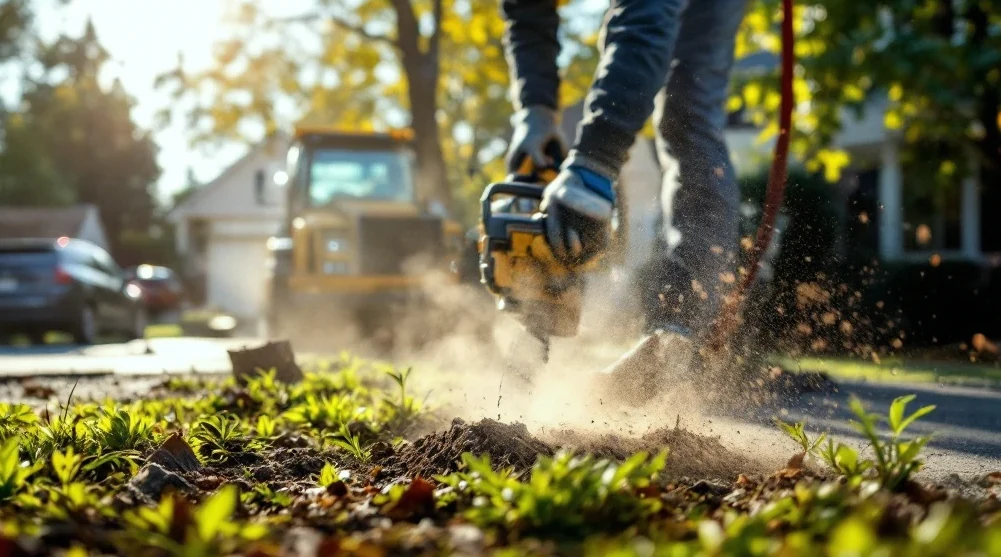
What is Right-of-Way Clearing and how does it work?
Right-of-way clearing removes vegetation and other obstructions along the designated path where utility pole lines are installed. It creates a safe, easy path for installing and maintaining power lines and utility infrastructure. (geostabilization.com)
Think of the strip of land that runs under and around power lines, water lines, or sewer lines. That's the right-of-way. It's not your yard, exactly, but it's on your property, and the utility company has a legal easement to access it. Our job is to keep that strip clear so crews can get in, work, and get out without fighting a wall of kudzu or a fallen oak.
In Birmingham, that strip can be anywhere from 4 to 8 feet wide, depending on the utility and the terrain. (bamalandclearing.com) We've cleared paths that run behind a whole row of houses, where the only access is a narrow gate. We've also worked along main roads where the right-of-way is wide open but packed with brush that's been left alone for years.
The work itself is straightforward: we cut down trees, grind stumps, mow brush, and haul away the debris. But the reason it matters is what happens if you don't do it. Overgrown vegetation can bring down lines in a storm, block a repair crew from reaching a fault, or hide a leak in a water line until it's caused significant damage. Keeping the path clear is preventive maintenance, and it's a lot cheaper than an emergency fix.
- Clears trees, brush, and stumps along utility easements
- Keeps access open for power, water, and sewer line maintenance
- Prevents storm damage and hidden leaks from overgrowth
- Typical width in Birmingham is 4 to 8 feet
Short version
- Right-of-way clearing is about keeping utility lines accessible and safe.
- It's a narrow strip, usually 4 to 8 feet wide, on your property.
- Neglecting it can lead to power outages and expensive repairs.
- Costs vary widely based on how thick the vegetation is.
How Right-of-Way Clearing works, start to finish
We start with a walk-through to see what's growing, then we cut, grind, and haul. The whole process usually takes a day or two, depending on how thick the brush is and how much access we have.
First, we walk the line with you. We look at what's there: a few saplings, a tangle of vines, or a stand of mature oaks. That tells us what equipment to bring. For light work, a brush hog and a chainsaw might do. For heavy stuff, we're talking about a skid steer with a mulching head and maybe a crane if there are big trees near the lines.
Next, we get the right permits. In Birmingham, you often need a permit to clear within a certain distance of a utility easement, especially if you're cutting trees that could fall on lines. We handle that paperwork as part of the job, so you don't have to chase it down.
Then we clear. We cut trees in sections if they're close to power lines, grind stumps down below grade, and mow or mulch the brush. We also haul away everything we cut, unless you want to keep some firewood. Leaving debris behind just creates a new problem, so we don't do that.
Finally, we do a walk-through with you to make sure the path is clear and the lines are accessible. We also flag any spots where the utility company might need to do their own work, like trimming branches that overhang the lines but are outside the easement.
- Walk the line.We assess the vegetation and access points, and you tell us about any buried lines or property corners.
- Get permits.We pull any needed permits for work near utility easements, so you don't have to.
- Cut and clear.We fell trees, grind stumps, and mow brush, working around live lines when needed.
- Haul away.We remove all debris, leaving the right-of-way clean and passable.
- Final check.We walk it together to confirm the path is clear and note any utility follow-up.
Why Right-of-Way Clearing matters for your home
A clear right-of-way means your power stays on during storms, repair crews can reach problems fast, and you avoid the cost and hassle of emergency tree work. It's a small investment that protects your home's most basic services.
Here's a scenario we see every spring. A homeowner calls us because their power flickers every time the wind picks up. We walk the line and find a sweetgum branch rubbing against the service drop. It's been there for months, slowly wearing through the insulation. One good thunderstorm and that branch takes the line down, knocking out power to the whole block. A right-of-way clearing would have caught that branch before it became a problem.
It's not just about power. Water and sewer lines run through the same easements. If a line leaks, the utility company needs to dig it up. If the right-of-way is choked with briars and saplings, they can't get their equipment in. That means the leak sits there, wasting water and maybe undermining your foundation, while the utility waits for you to clear access. We've seen that happen, and it's not a cheap fix.
There's also the matter of liability. If a dead tree on your property falls on a power line, you could be on the hook for the damage, not just the utility. Keeping the right-of-way clear reduces that risk. It's one less thing to worry about when a storm rolls through.
Finally, think about resale. A clean, accessible right-of-way is a selling point. Buyers don't want to inherit a jungle they can't mow. When we clear a path, it makes the whole property look better and easier to maintain.
A clear right-of-way is the difference between a quick fix and a week without power.
Common problems and what causes them
The most common issues we see are overgrown brush hiding utility access, trees too close to lines, and erosion from cleared slopes. Each has a specific cause and a fix that's cheaper if you catch it early.
Overgrowth is the big one. In Birmingham's humid climate, kudzu and privet can take over a right-of-way in a single growing season. If it's left for a few years, you've got a wall of green that no utility crew can get through. We've cleared paths that were literally impassable, and it took a full day just to get the equipment in.
Trees growing too close to lines are another issue. Some species, like water oaks, have shallow roots and drop limbs in high winds. If a tree is within striking distance of a line, it's a hazard. We recommend clearing any tree that could reach the lines if it fell, even if it's outside the easement. It's a judgment call, but we'll walk it with you and give you our take.
Erosion is a sneaky problem. When we clear a slope, the bare soil can wash out in a heavy rain, taking the topsoil with it and exposing roots. We deal with this by leaving a buffer of low ground cover or installing silt fence if the slope is steep. It's not glamorous, but it keeps the right-of-way stable.
Then there's the cost question. In Alabama, clearing a lightly vegetated area runs about $500 to $1,200 per acre. (meekslandmanagement.com) Heavily wooded areas are a different ballgame, at $3,000 to $10,000 per acre. (meekslandmanagement.com) That's a big range, and it depends on how many trees, how big they are, and how far we have to haul the debris. Most residential right-of-way jobs fall on the smaller end, but if you've got a long stretch of mature woods, expect the higher number.
We've also seen bids for larger municipal projects that give you a sense of scale. One bid in Alabama covered about 21 miles of water and sewer lines, with line clearing amounts around $69,000 to $88,000. (alabamabids.com) (opelika-al.gov) That's for miles, not your backyard, but it shows why regular maintenance beats a big catch-up job.
Light brush and saplings
A few hours with a brush hog keeps it in check. Do this every year or two.
Trees within falling distance of lines
These need to come down before a storm brings them down. Call us this season.
Overgrown access blocking utility work
If a crew can't get in, you're looking at delayed repairs and potential fines. Clear it now.
Sources
Need land clearing in Birmingham? Get a free estimate today.
📞 256-587-8568